
Sydney Opera House
Sydney, NSW
Sydney, NSW
Architect: ARM Architecture
Builder: Waagner Biro
Product: ShapeShell™-RT
Area: 18 Acoustic Reflectors
Application: Special Building Feature
Responsibility: Design, Engineer & Manufacture of Feature Elements
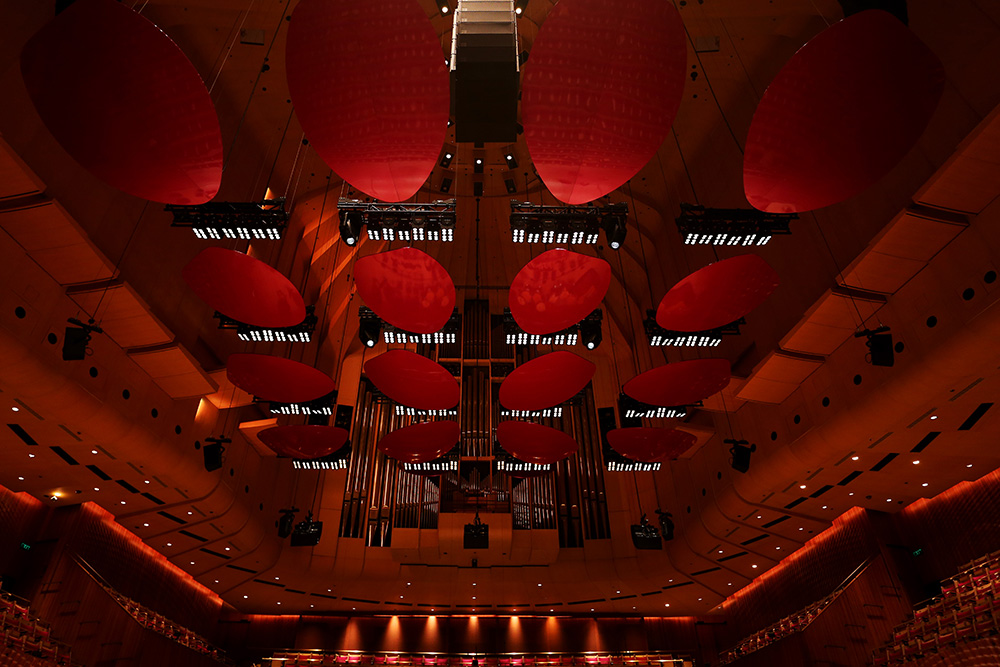
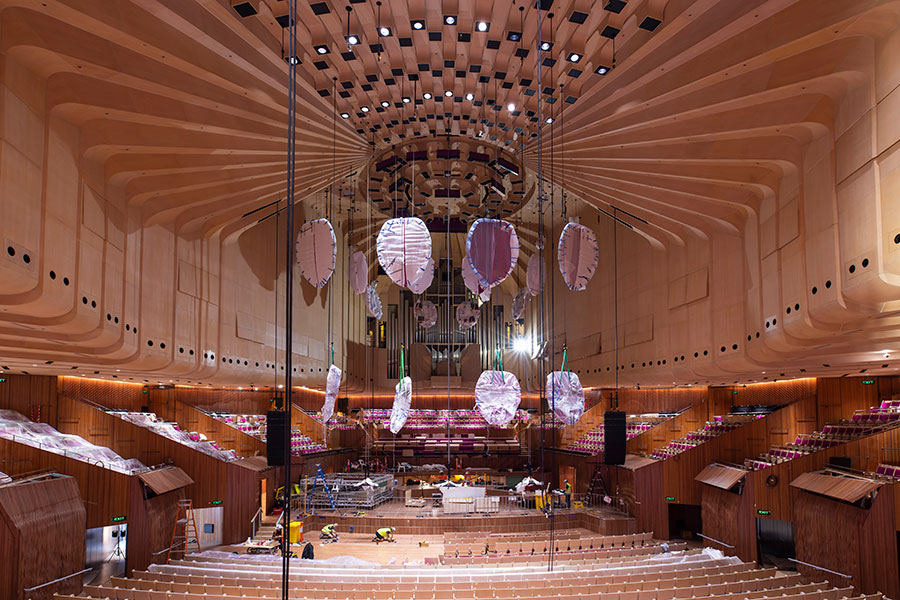
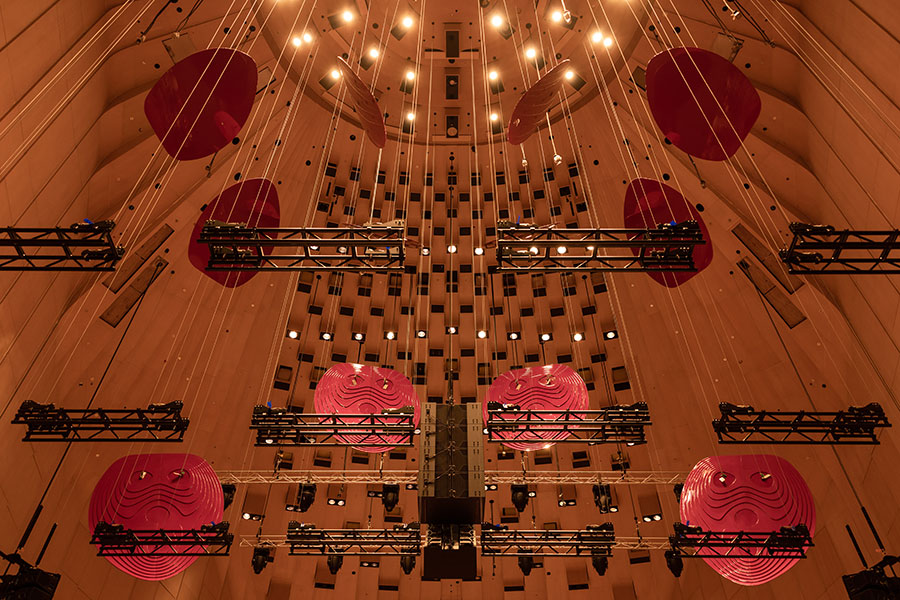
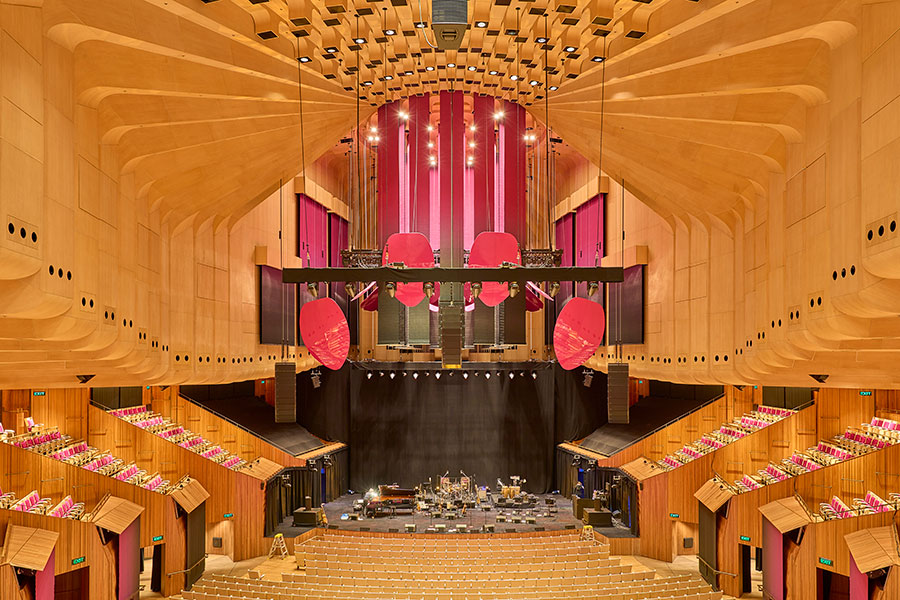
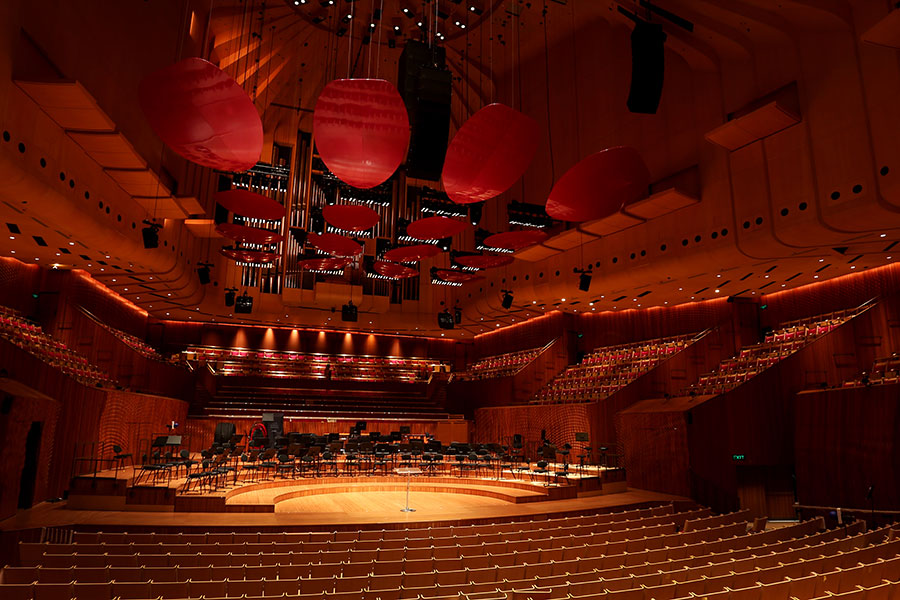
The Sydney Opera House Concert Hall underwent a significant renovation in 2022, aimed at enhancing its acoustics, accessibility, and stage functionality while preserving its iconic status. The project included the replacement of outdated acoustic features with 18 state-of-the-art sound reflectors, designed to optimise sound quality for a variety of performances.
This unique structure functions as an acoustic reflector. Made from composite fiberglass, the petals can be positioned to reflect sounds to pre-determined areas of the venue as well as adapt to different types of performance. Designed by ARM Architecture in conjunction with highly experienced German acousticians Müller BBM.
The large audience reflectors weigh approx. 160kgs while the smaller orchestra petals weigh approx. 80kgs. This acoustic reflectors above the stage have replaced the old clear acrylic ‘donuts’. These ‘acoustic petals’ are set in a range of different positions, depending on the music being played. They have been finished in a semi-gloss magenta – matching the colour of the Concert Hall seats chosen by architect Peter Hall.
ShapeShift Technologies played a pivotal role in this upgrade by supplying customised ShapeShell™ RT sound deflectors, engineered to deflect and diffuse sound waves for balanced acoustics. These advanced fibre-reinforced panels, often referred to as surfboard-shaped due to their unique design, were meticulously crafted to integrate seamlessly with the architectural aesthetic of the hall. The installation of these deflectors not only enhanced the auditory experience but also maintained the structural and visual harmony of the UNESCO World Heritage-listed building.
The Sydney Opera House Concert Hall reopened in 2022 after a renovation aimed at its acoustics, accessibility and stage functionality. Part of that work replaced the hall’s old clear acrylic donuts with 18 new acoustic reflectors, designed by ARM Architecture with the German acousticians Müller BBM and installed by Waagner Biro. ShapeShift manufactured the reflectors in ShapeShell™-RT: large audience reflectors weighing approximately 160 kg and smaller orchestra petals at approximately 80 kg.
An acoustic reflector works by returning sound rather than absorbing or passing it, and the usual way to make a surface do that across the full frequency range is to give it mass and stiffness. Everything suspended above a concert platform, meanwhile, wants to be as light as possible. It hangs from rigging over the heads of musicians and an audience, it has to be moved, and every kilogram is a load on a structure inside a World Heritage listed building that cannot simply be strengthened to suit.
Those two requirements pull directly against each other, and the reflectors are large. At roughly 160 kg for an audience reflector, these are extremely light for their size, which is the whole reason a fibre reinforced composite was the right answer rather than a compromise.
On an element like this the geometry is not styling. Müller BBM specified surfaces that deflect and diffuse sound waves to produce a balanced result across the hall, which means the curvature of each reflector determines where sound goes. A deviation from the designed surface does not make the reflector look slightly different, it sends energy to the wrong part of the room.
That puts the tolerance requirement closer to an engineered component than to architectural cladding. Each of the 18 pieces had to be manufactured to its designed surface, and the reflectors, often described as surfboard-shaped, are all different because their positions and acoustic jobs differ.
The petals are not fixed. They are set in a range of positions depending on the music being played, so the hall can be tuned for a symphony orchestra, an amplified act or a spoken performance. A moving suspended element is loaded differently in every position and is handled repeatedly over its life, so it has to hold its geometry and its finish through all of it. Nothing about a reflector can rely on being set once and left alone.
The reflectors are finished in a semi-gloss magenta that matches the Concert Hall seats, a colour chosen by architect Peter Hall. In a room this well known, a new element either belongs or it does not. Picking up an existing colour is what lets 18 pieces of contemporary acoustic engineering read as part of the hall rather than as equipment installed in it, and a semi-gloss finish on a compound curve is unforgiving of any flaw in the surface beneath it.
This application is the case for composites in one object. The reflectors needed a precise compound-curved surface, high stiffness so they do not flex or buzz, very low weight for suspension and motorised movement, a flawless pigmented finish, and 18 individually different geometries with no repetition to amortise tooling against. A moulded fibre reinforced laminate delivers all of those from the same process.
This project used ShapeShell-RT, our FRP composite system.
Browse all ShapeShift projects, or compare the panel materials in cladding panels compared.