
Wesley Place
Melbourne, VIC
Melbourne, VIC
Architect: Cox Architects
Builder: Lendlease
Product: ShapeShell™-RT
Area: Pillar Lobby
Application: Integrated Cladding with Light & HVAC Module
Responsibility: Design, Engineer & Manufacture of Feature Elements
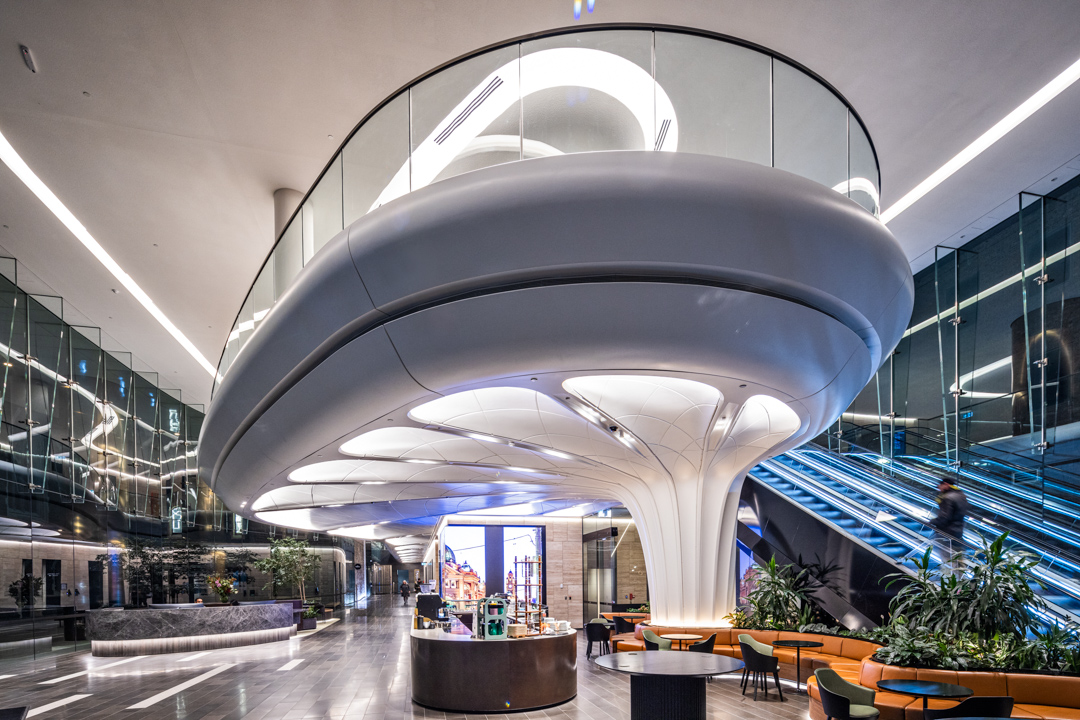

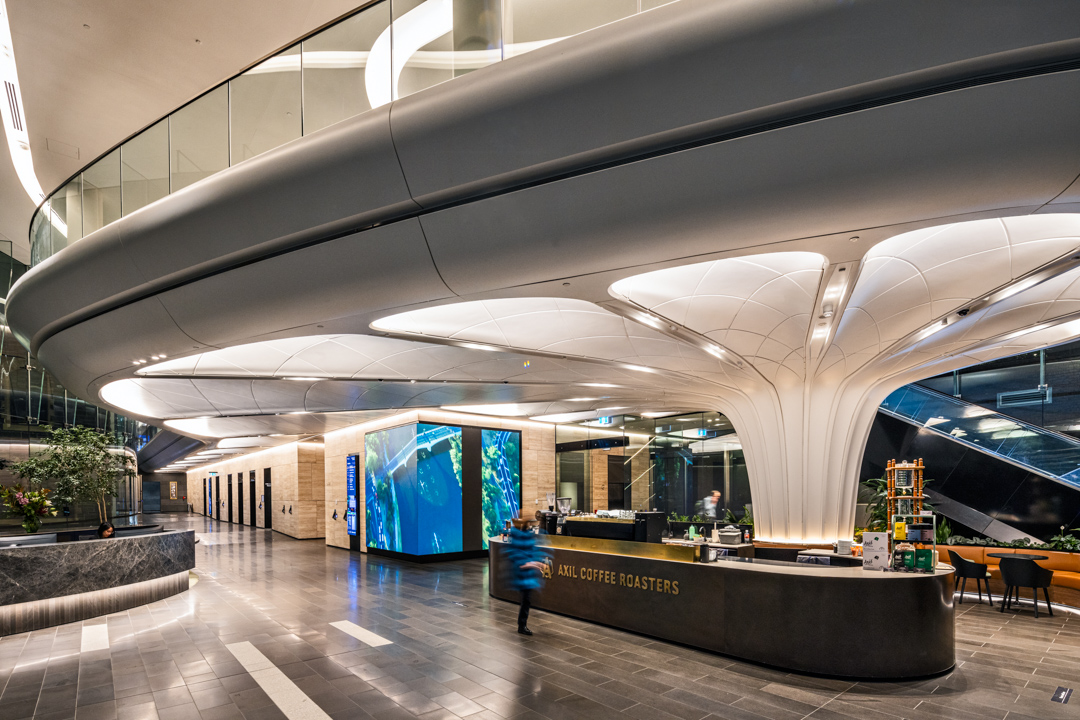


ShapeShift Technologies was engaged to deliver the lobby pillar wall panels for the main lobby, a high-traffic zone requiring both durability and refined detailing. Using ShapeShell™-RT, a lightweight fibre-reinforced polymer system, the panels were fabricated as thin-walled elements (15–25 mm) that balance strength with reduced weight. Large-format 5-axis CNC tooling ensured precise geometry and crisp surface fidelity, enabling seamless integration with the lobby’s architectural lines. The engineered mounting system incorporated ±20 mm on-site adjustability, allowing for accurate alignment despite structural tolerances, and simplifying installation within the tight constraints of an active city-centre site.
Surface finishes used protective PVDF coatings. By combining advanced materials, sustainability innovation, and precise fabrication, ShapeShift Technologies delivered a solution that reinforced the lobby’s character as both a welcoming public threshold and a robust structural environment.
Wesley Place is a commercial development in central Melbourne. ShapeShift clad the lobby pillars in ShapeShell™-RT, a lightweight fibre-reinforced polymer, for architect Cox Architects and builder Lendlease. The panels were manufactured as thin-walled elements between 15 and 25 mm thick, tooled on large-format 5-axis CNC equipment, and fixed with an engineered mounting system providing plus or minus 20 mm of on-site adjustability.
The Wesley Place lobby required a cladding solution that could accommodate the existing structure while maintaining the architectural intent of the design. The key considerations were weight, panel coordination, joint control and integration with building services.
The lobby pillars required a substantial architectural finish, but adding significant dead load to the existing structure was undesirable. ShapeShell™-RT provided a lightweight solution, allowing the pillar cladding to be formed as thin-walled panels while maintaining the required architectural geometry.
The pillars were divided into modular panels to make fabrication, handling and installation more manageable. The modular approach also gave the architect control over how the joints were expressed.
The pillar cladding was also coordinated with the lobby’s building services, including lighting and HVAC installations. Rather than treating the cladding as a separate finish installed around completed services, the panel modules were developed to work with the service modules within the overall architectural arrangement.
With ShapeShell™-RT available in lightweight configurations, the cladding could achieve the required form without the mass associated with a solid concrete element. The material data sheet lists typical ShapeShell™-RT weight at 5–32 kg/m², depending on configuration.
Depending on the design intent, the joints could be visually minimised or deliberately expressed as part of the architectural pattern. The engineered attachment system provided up to ±20 mm of on-site adjustment, allowing installers to align individual panels and manage variations in the building structure.
This required coordination between the panel geometry, fixing locations and service interfaces so that lighting and HVAC elements could be accommodated without compromising the visual continuity of the pillars.
A lobby is the highest-traffic surface in a commercial building and the one most closely inspected. Pillars in particular are leaned on, knocked by trolleys and cleaned constantly. A cement-based panel with its finish in the material rather than on it survives that treatment in a way a coated substrate does not, because cleaning the surface does not remove the surface.
This project used ShapeShell-RT, our FRP composite system.
Browse all ShapeShift projects, or compare the panel materials in cladding panels compared.